Mahi Toi
Mahi Toi is a creative and engaging way to share our stories, celebrate our journey and reinvigorate the area.
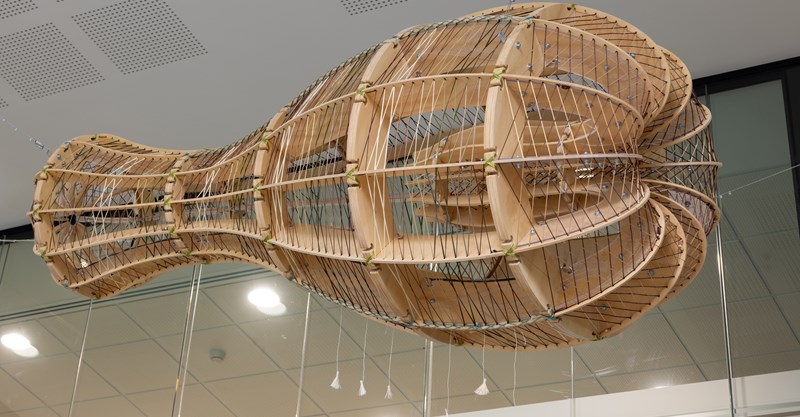
Hina
Bernadette Papa (Ngāti Whātua, Te Roroa, Ngāpuhi), Kade Cowper (Ngāti Kahungunu) & Ruth Woodbury (Ngāpuhi, Ngāti Whātua) - 2023
Hina is our latest hanging art piece that adorns the ceiling space above Māhuhu Eatery here in AECOM House.
Hina was designed and created by our very own whānau, Bernadette Papa who is a Ngāti Whātua, Te Roroa, Ngāpuhi weaver, fibre artist, and environmental kaitiaki, in collaboration with Aka Whiro who are a master carver and weaver duo - Kade Cowper (Ngāti Kahungunu) and Ruth Woodbury (Ngāpuhi, Ngāti Whātua) who are based in Motutoa & Omanaia, Hokianga.
The hinaki is a traditional food gathering tool that was used to capture tuna (eels) which was a great indicator of environmental and economical sustenance for the iwi. The hīnaki design was inspired by the whakatauki "Te pai me te whai rawa" which refers to the wealth and abundance of the iwi. The skeleton of Hina is made up of tuna which bind together and creates the hīnaki. These tuna are associated with the awa that flow into Te Tōangaroa – Waipapa, Waipāruru, Waiariki.
Hina symbolises both the traditional and economical representation of wealth and abundance here in Te Tōangaroa.
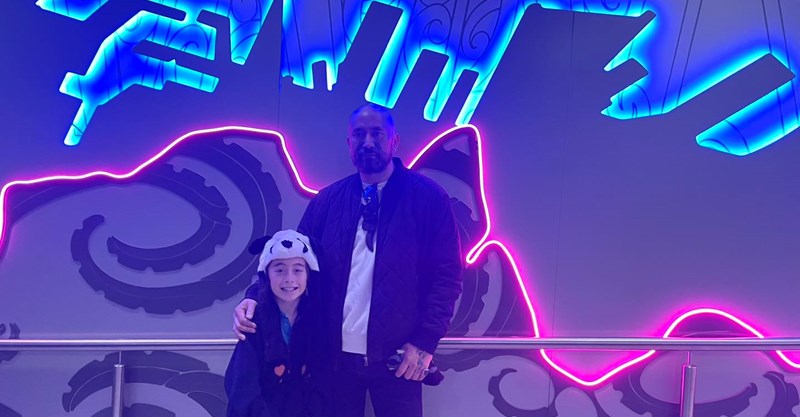
Tai Timu
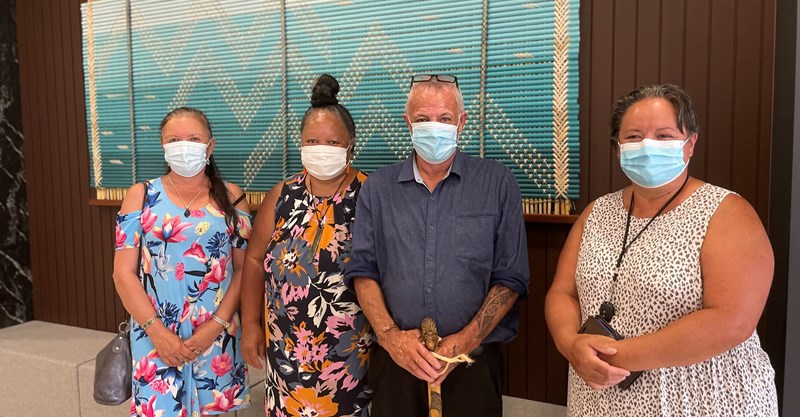
Te Tumu Herenga Waka
Ngāti Whātua Orākei Kai Rāranga - Beronia Scott, Ruth Cullen Scott, Shelley Faiers, Kororia Witika, Rebecca Reid, Te Whaea Witika - 2023
AECOM House, located in the heart of Te Tōangaroa in Tāmaki’s CBD, is now home to the latest Toi Māori piece designed collaboratively by members of Ngāti Whātua Orākei whānau kai raranga - Beronia Scott, Ruth Cullen Scott, Shelley Faiers, Kororia Witika, Rebecca Reid, Te Whaea Witika.
Gifted the name Te Tumu Herenga Waka, meaning the mooring post, it uses the weaving pattern Aramoana (pathway to the ocean) to share a piece of the history of Te Tōangaroa.
AECOM House is one of the commercial investment properties belonging to the hapū and this piece was commissioned to inspire pride amongst the workplace, adding to the cultural design within the wider precinct.
This tukutuku represents where tangata whenua would moor their waka and trade their goods or stop for a rest. The toetoe on front of the panel represents the tumu (post) which the waka would be tied to.
Next time you’re in Te Tōangaroa make sure to check out this stunning piece of art, kept on the ground floor of AECOM House.
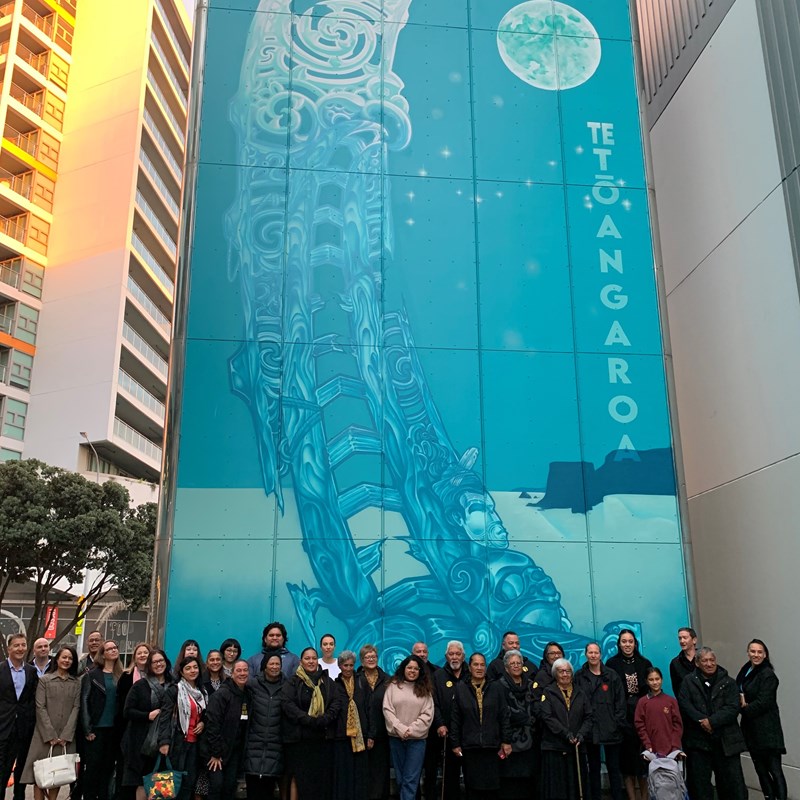
In 2021, we commissioned Hana Maihi of Ngāti Whātua Ōrākei and Te Whetū Collective member Poi Ngawati to design and install two sides of a 12m high air vent on corner of Dockside Lane and Tangihua Street.
Students Nikita Sharma, Celia Lee and Jenny Zhong were chosen to design and paint the remaining panel after Study Auckland invited art students to join the project. The aim of the Study Auckland panel was to give international students the opportunity to work with respected local artists Ross Liew, Hana and Poi and explore what it means to make public art in Aotearoa.
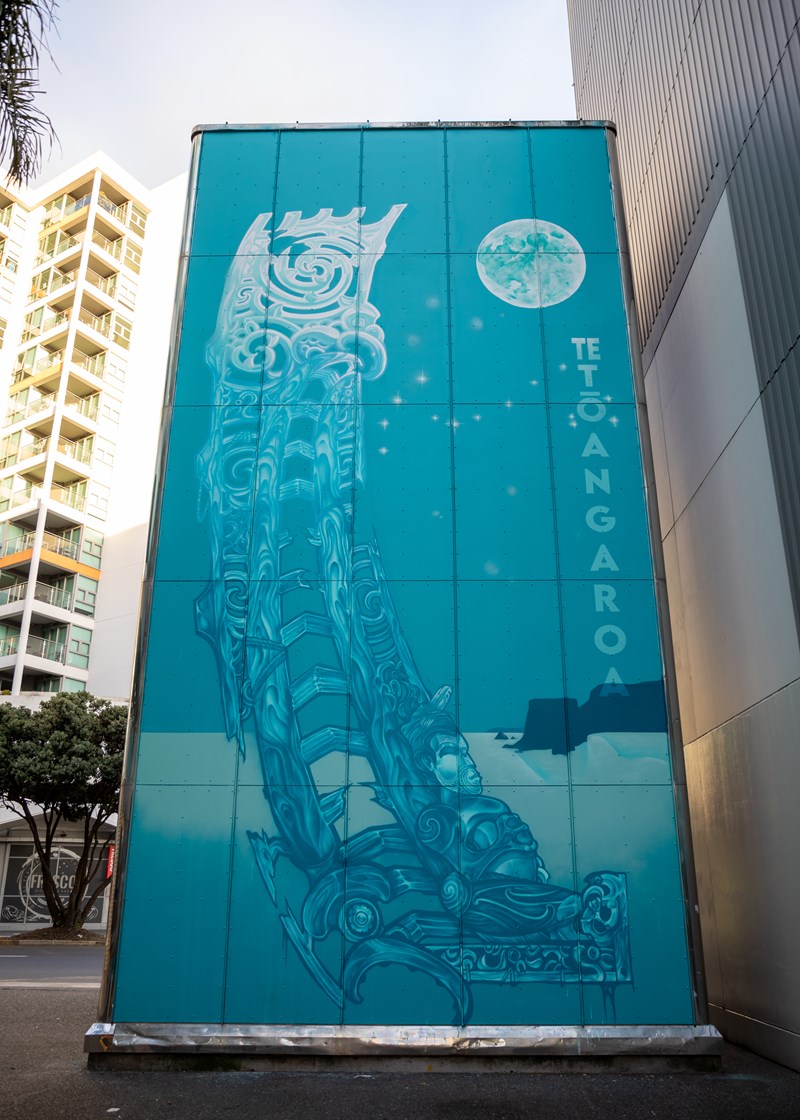
Te Tōangaroa
Hana Maihi (Ngāti Whātua Ōrākei, Ngāti Whātua Kaipara), Poi Ngawati - 2021
The images depicted in this mural acknowledge Te Tōangaroa and Tāmaki Herenga Waka, the name of the place this mural now stands. Both names speak to the dragging and mooring of waka.
The waka taurapa (carved stern-post) evokes ‘Te Pou Whakairo ka tū ki te Waitematā’ gazing out over the Waitematā toward Tokapurewha and Takaparawhau where the haukainga of Te Taou, Te Uringutu and Ngaoho stand and have stood over many generations.
The taurapa acknowledges the rangatira steering us toward Te Ao Marama and each individual steering their own waka in life within the collective.
Ngā tohu o te rangi, the stars and signs above alongside ngā tohu o te taiao (signs of the environment) guide the kaiurungi (steerer) on the journey of the waka into the future.
The star constellation depicted is Te Matau a Maui, that can be seen in the location depicted with the rising of marama, prior to Hine Takurua and the rising of Matariki. This was visible in the location depicted in the mural at the time of painting.
With the long setting of the sun, Rākaunui (full moon) emerges from Tāne-te-waiora high in the sky. This acknowledges the phases of the moon, like the ebb and flow of the tides, that symbolise ‘ngā piki me ngā heke’ the good times and the challenges that our people move through towards te Ao Marama, enlightenment and well-being.
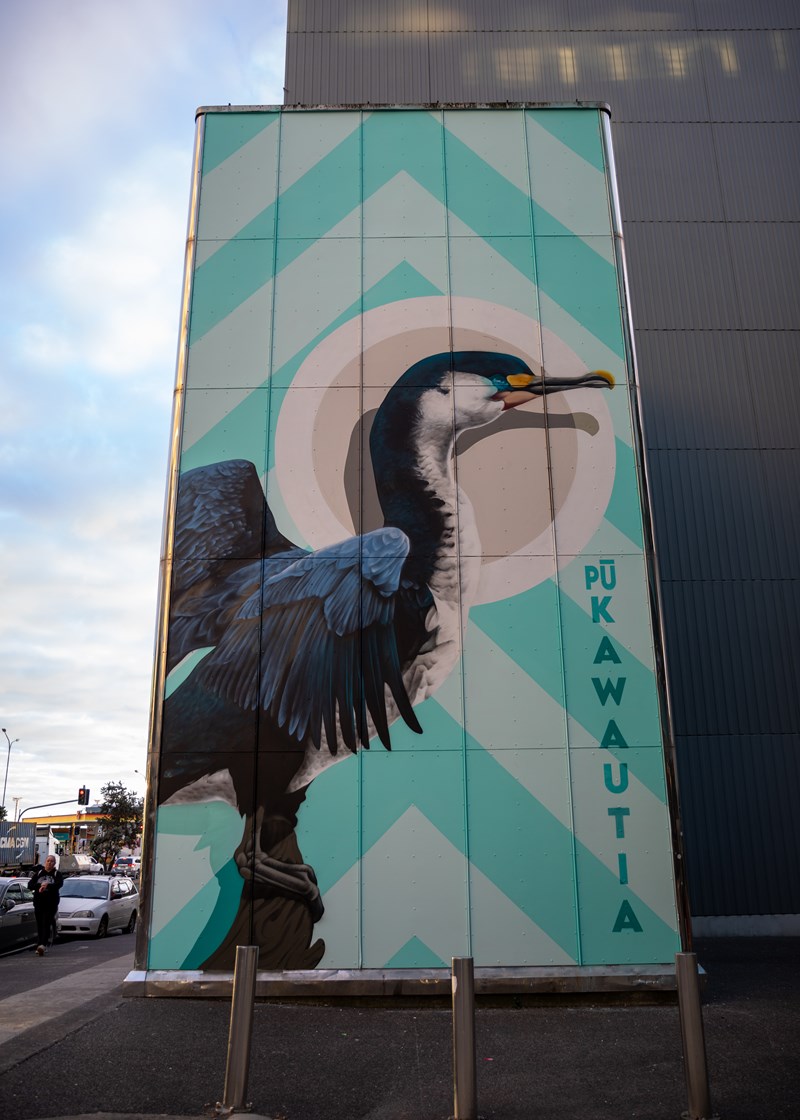
Pū Kawautia
Hana Maihi (Ngāti Whātua Ōrākei, Ngāti Whātua Kaipara), Poi Ngawati - 2021
The purpose of this mural is to empower, ground and stand as a reminder of the unwavering whakapapa and wairua from the ancestors to the descendants of today. This is depicted through a side profile of the kawau pū standing tall.
Kawau birds are commonly found near coastal waters, rivers, streams. The kaokao raranga design as seen in the background symbolises the shelter and protection.
The colours in the kaokao reflect te korowai ora, the cloak of healing waters from Ranginui ki a Papatūānuku. These life-giving waters stretch from maunga to moana, thus connecting everything in between.
“I tā te kawau, ruku”, Dive determinedly like the cormorant and you will be rewarded. Dive into the depths of Te Ao Māori and Te Reo Māori. “Pū kawautia”, stand firm in your mana, in your whakapapa. Be unwavering in life and pursuit and protect your whatutoto that which you love.

Ngā Wai o te Ata Hāpara
Hana Maihi (Ngāti Whātua Ōrākei, Ngāti Whātua Kaipara), Poi Ngawati - 2022
The artwork depicts a tiheru (bailer) and is inspired by the glistening waters of Te Waitematā that Te Tōangaroa overlooks where Te Uringutu, Te Taoū and Ngaoho have stood over many generations.
The first mural depicts the dragging and mooring of waka with the purpose to empower, ground and stand as a reminder of the unwavering whakapapa and wairua from the ancestors to the descendants of the iwi.
Ngā wai o te ata hāpara honours the important roles and responsibilities that everyone has in navigating our journey through trials, tribulations, celebrations and the challenges that lay ahead, reminding us all no matter how significant or insignificant you may feel, you are important!
“Many Tui are seen to be passing by each sharing matauranga, waiata and kōrero. Tūī traverse the heavens waters to share their wai-o-te-ata hāpara, the songs of the new dawn.”

Te Herenga Waka
Hana Maihi (Ngāti Whātua Ōrākei, Ngāti Whātua Kaipara), Poi Ngawati - 2023
Te Herenga waka’ is a mural that depicts our ancestors who voyaged across Te Moana Nui a Kiwa to Aotearoa, signified by the kiwa Manu a significant migration bird.
It acknowledges our ancestral waka Māhuhu-ki-te-rangi that was captained by Rongomai. The mural illustrates their tupuna that came from Hawaiki. It showcases the trials and tribulations they had to go to find other lands, as well as complete the voyage to reconnect with whānau already on the whenua.

Tara Iti
Hana Maihi (Ngāti Whātua Ōrākei, Ngāti Whātua Kaipara), Poi Ngawati - 2023
The tara iti is a significant manu to Ngāti Whātua, often found in the Kaipara and in central Tāmaki.
Te Tara Iti ki Tai is an acknowledgement of our hononga to the Kaipara and a contemporary take on whakairo, created using a CNC router and features Te Whetu Collective's signature green to represent the Waitematā.

Te Tōanga o te Rā
Hana Maihi (Ngāti Whātua Ōrākei, Ngāti Whātua Kaipara), Poi Ngawati - 2023
This piece talks to the earlier mural of the Taurapa. We wanted to acknowledge the korero that emerged from ingoa of this place and the notion of the dragging of the waka.
This colours speak to Te Tōanga o Te Ra, the long dragging of the sun across the horizon toward Hine Raumati, the summer maiden. In this depiction is of the tipua of te Kahu Pokere guiding our waka.

Te Pou Takiri ki Tua
Hana Maihi (Ngāti Whātua Ōrākei, Ngāti Whātua Kaipara), Poi Ngawati & Arakatrea Maihi (Ngāti Whātua Ōrākei, Ngāti Whātua Kaipara - 2024
The concept depicts a waharoa that celebrates the whakapapa of Tāngata whenua and pays homage to the history of Te Puru o Tāmaki.
Building on the kōrero carried through the mural narratives along Te Tōangaroa, this concept speaks to the journey and evolution of purpose found in the purakau (the stories and expressions) of Tāne. From a tree (rākau) that stood tall in the ngahere, that was felled for the purpose of waka and the journey into the unknown, through to its final repurposed form of a waharoa (carved pillar or gateway).
Upon arrival to the shores of Te Waitemata, Aotearoa the waka takes a new form - ‘Te Pou whakairo’ the divine gateway protecting and grounding the pātūwatawata the fortified home of the people. The symbolism of this waharoa talks to the korero of ‘Te Puru o Tamaki’, the history of the people and place of Tāmaki being the waharoa, the gateway to filter and channel those seeking to traverse north or south through the Tāmaki isthmus. The waharoa is also symbol of the sacred gateway endowed with whakapapa and kōrero tuku iho of tāngata whenua that filters incomers into Te Pātūawata and Te Ao Marama, the living Māori world.
In todays day and age of mass distraction, we live in a world that incentivises the colonisation of our internal and external landscapes. We live in an era that rewards when we carry out the colonisation toward our taiao, own people and each other. In the face of this, the waharoa stands as a reminder that we must hold fast to our taonga tuku tho, to our tīkanga and fiercely, guard, protect and nurture the pātūwatawata of our minds.

Poutokomanawa
Chaz Doherty (Ngāti Whātua) & Arekatera Maihi (Ngāti Whātua Ōrākei & Ngāti Whātua Kaipara) - 2008
The poutokomanawa in whare rūnanga symbolise ancestors significant to Māori. Here, the poutokomanawa recognises the enduring status and vibrancy of people of Ngāti Whātua Ōrākei in Tāmaki Makaurau, even as the city’s urban environment evolves. The work is made up of pou (carved posts) and kōhatu (boulders). Inscribed on the boulders are the words ‘He kākano ahau i ruia mai i Rangiātea - I am a seed sown from Rangiātea’.
This message emphasises the excellence of ancestors and reinforces the potential of their descendants. The pou inside the arena and forecourt symbolise the continued occupation by descendants of the great pā (fortified villages) sites in Auckland: Maungawhau (Mount Eden), Maungakiekie (One Tree Hill) and Waipapa (near The University of Auckland marae).

Tauranga Waka
Chris Bailey (Te Aupōuri, Ngāti Hako, Ngāti Porou) - 2018
Bailey created a series of five bronze waka sculptures. The group was name Tauranga Waka meaning 'the resting place of canoes'. The location of the Waka marks the original shoreline before reclamation began in 1860. The earth used for the reclamation was taken between 1860 and 1880 from Tangihanga Pūkaea where Te Reuroa Pā once stood. Bailey's waka emerger from the path as though they are being pulled from the moana to the shore. These are not Waka Taua, rather waka that were used to collect kai and to transport people.



{{title}}
{{descript}}